AI Segmentation
-
Automatically identify and segment anatomical structures from CT volumes using deep learning models.
- The AI Segmentation tool applies nnU-Net v2 deep learning models to a loaded CT volume to identify and segment anatomical structures automatically, producing selectable and interactable segments without manual outlining.
Note: The AI Segmentation tool is intended for assistive use only. The segments it produces must be reviewed and corrected by a qualified user before they are exported or used for any other task.
The AI tool is located in the tools panel of the Segment Editor.
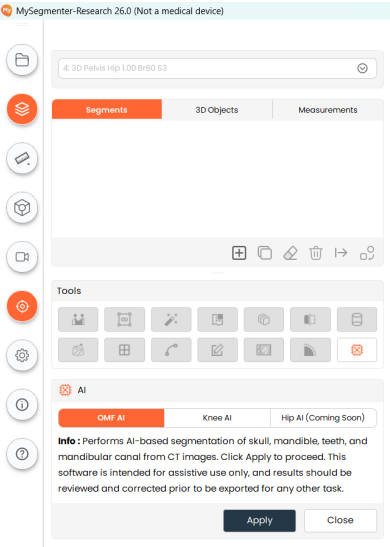
Steps:
- Load the CT volume to be segmented and confirm that a segmentation is available in the Segments tab. The tool validates that both a source volume and a segmentation node exist before it proceeds.
- Choose the AI tool from the tools panel of the Segment Editor. The AI panel opens beneath the tools panel.
- Select the model to run from the model selection buttons: OMF AI, Knee AI, or Hip AI. The Info label below the buttons lists the structures the selected model segments and restates the assistive-use disclaimer.
- Click Apply to run the selected model, or Close to leave the panel without running it.
- The first time a model is run, a single confirmation dialog describes all of the components that must be downloaded. Accept it to continue, or cancel to return to the panel without downloading anything.
- Follow the progress dialog, which covers the whole workflow: PyTorch installation, model download, and inference. Click Cancel at any point to stop the workflow.
- When inference completes, the resulting segments are added to the Segments tab, where they can be selected, edited, and used like any other segment.
Additional Information
Model Selection
- OMF AI: Performs AI-based segmentation of the skull, mandible, teeth, and mandibular canal from CT images.
- Knee AI: Performs AI-based segmentation of the knee anatomical structures from CT images.
- Hip AI: Performs AI-based segmentation of the hip anatomical structures from CT images.
- Each model carries its own configuration — thresholds, download locations, and model parameters — which is applied automatically when the model is selected. No manual parameter entry is required.
- Only one model runs at a time. Selecting a different model updates the Info label and the configuration used by Apply.
Hip AI
Hip AI segments the bony structures of the pelvis and proximal femur from a CT volume. It produces four separate segments, each named and coloured independently so that left and right structures can be reviewed, edited, and exported on their own:
- Right Femur
- Left Femur
- Right Pelvis
- Left Pelvis
The results are standard segments: they appear in the Segments tab and can be refined with any of the segmentation tools described in this manual, converted to 3D objects, measured, or exported.
First-Time Setup and Downloads
- The first time an AI model is used, the required deep learning components must be installed. A single confirmation dialog describes every download that is needed before any of them begins.
- The components include the PyTorch runtime and the weights of the selected model, which are retrieved from the download location defined in that model’s configuration.
- An internet connection is required for the initial download. Once the components are installed, subsequent runs of the same model do not download them again.
Progress and Cancellation
- A single progress dialog covers the entire workflow — PyTorch installation, model download, and inference — so the stage in progress is visible at all times.
- The workflow can be cancelled from the progress dialog at any stage. Cancelling stops the workflow and leaves the existing scene unchanged.
- Processing time depends on the size of the volume and on the available hardware. A dedicated GPU, configured as described in the GPU Configuration section, significantly reduces inference time.
Reviewing AI Results
- AI results are a starting point, not a final segmentation. Inspect every segment slice by slice in the 2D views and in the 3D view before using it.
- Correct any under- or over-segmentation with the Edit Segment, Islands, Smoothing, or Morphological tools, and verify that left and right structures are correctly identified.
- Segments produced by the AI Segmentation tool must be reviewed and corrected before they are exported, converted to 3D objects, or used for pre-operative planning or educational purposes.